By Sarah Morales
The Chapman University Holocaust Art & Writing Contest is an annual educational event that encourages middle and high school students to reflect on the history of the Holocaust through creative expression. Organized by the Rodgers Center for Holocaust Education in partnership with The 1939 Society, the contest brings together students from across the United States and around the world to honor the experiences of Holocaust survivors and ensure their stories are remembered.
The main goal of the contest is to educate young people about the Holocaust while encouraging empathy, reflection, and creativity. Students begin by studying testimonies from Holocaust survivors. After engaging with these personal stories, they create their own responses through artistic or written work. According to Chapman University, the contest was created to help students connect emotionally with survivor stories and develop a better understanding of the human impact of the Holocaust (Chapman University, 2026).
By combining historical learning with creative expression, the contest helps students understand the human impact of the Holocaust rather than viewing it only as a series of historical facts. Many participants describe the experience as powerful and meaningful because it connects them with real-life stories of resilience, suffering, and hope. This approach allows students to see history not as just something to memorize, but as something deeper and more emotional.
Students are given the opportunity to submit entries in several creative categories: visual art, film, poetry, and prose (short essays). Each school can submit a limited number of entries, with one entry allowed per student. The contest provides an opportunity for students to communicate their understanding of Holocaust history in personal and creative ways. The theme for the 2025–2026 contest is “Holding on to Hope.” Students are encouraged to explore how hope helped people survive during the Holocaust and today. Many survivors described hope as a powerful force that kept them alive even during the darkest times. The theme invites students to reflect on the importance of courage, resilience, and belief in a better future.
Students who win the contest receive cash prizes and recognition for their work. First-place winners in each category can receive $400, while second-place winners receive $200. Teachers and schools associated with the winning students may also receive awards. Beyond prizes, the contest provides students with the chance to share their work with a large audience, including educators, community members, and sometimes Holocaust survivors themselves. Since it began in 1999, the contest has grown into one of the largest Holocaust education initiatives for students. Nearly 160,000 students and more than 2,000 educators have participated, with submissions coming from dozens of states and multiple countries (Chapman University, 2026). Through art and writing, students help keep the memory of Holocaust victims and survivors alive. As the number of living survivors decreases over time, programs like this play a crucial role in preserving their stories for future generations.
For students at Long Beach Polytechnic High School, events like the Chapman Holocaust Art & Writing Contest offer an important opportunity to connect history to the present. Long Beach Polytechnic High School is a diverse community with students from many different backgrounds and cultures. Learning about the Holocaust helps students recognize the real-life consequences of hatred and prejudice. Students often find the experience deeply impactful because it connects them to real-life stories and highlights the consequences of hatred, discrimination, and prejudice when these issues are allowed to grow unchecked.
Mx. Eddy Souter, a teacher at Long Beach Polytechnic High School, has participated in this contest for about twenty years. They attended the event this year and explained, “These experiences help students build real connections to history. Hearing directly from Holocaust survivors makes the learning more meaningful than simply reading about it in a classroom. It also reminds students that hatred and genocide are not just events of the past, they can still happen today. In addition, contests like this help students at Poly discover and express their hidden artistic talents, while also bringing recognition to the school.”- Mx. Eddy Souter.
In today’s world, where discrimination and hate speech still exist both online and in real life, these lessons are especially important. Additionally, today’s teenagers are among the last generations who may have the opportunity to hear directly from Holocaust survivors. Their presence serves as a powerful reminder of resilience and survival. Survivors sharing their stories today prove that, despite attempts to erase them, they endured. Listening to their experiences encourages students to value truth, stand against injustice, and ensure that history is never forgotten.
Overall, the Chapman Holocaust Art & Writing Contest is much more than just a competition; it is an opportunity for students to reflect, create, and take responsibility for remembering history. By participating, students not only honor the past but also gain a deeper understanding of their role in shaping a more compassionate and informed future. Programs like this remind students that history is not just something to study, but something to learn from and carry forward.
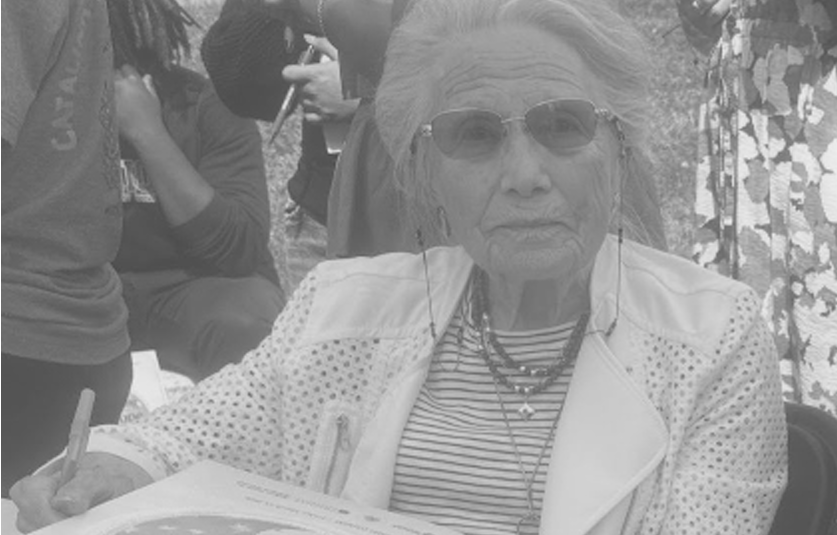
Photo by Sarah Morales
Holocaust survivor Tova Rotlevy Cohen is seated signing a booklet for a student attending the Chpaman Holocaust contest, and in the booklet Cohen says, “Thank you for being a witness.” She wrote that down because being a witness matters, it keeps truth alive, and educates younger generations.